By Noman Arshad

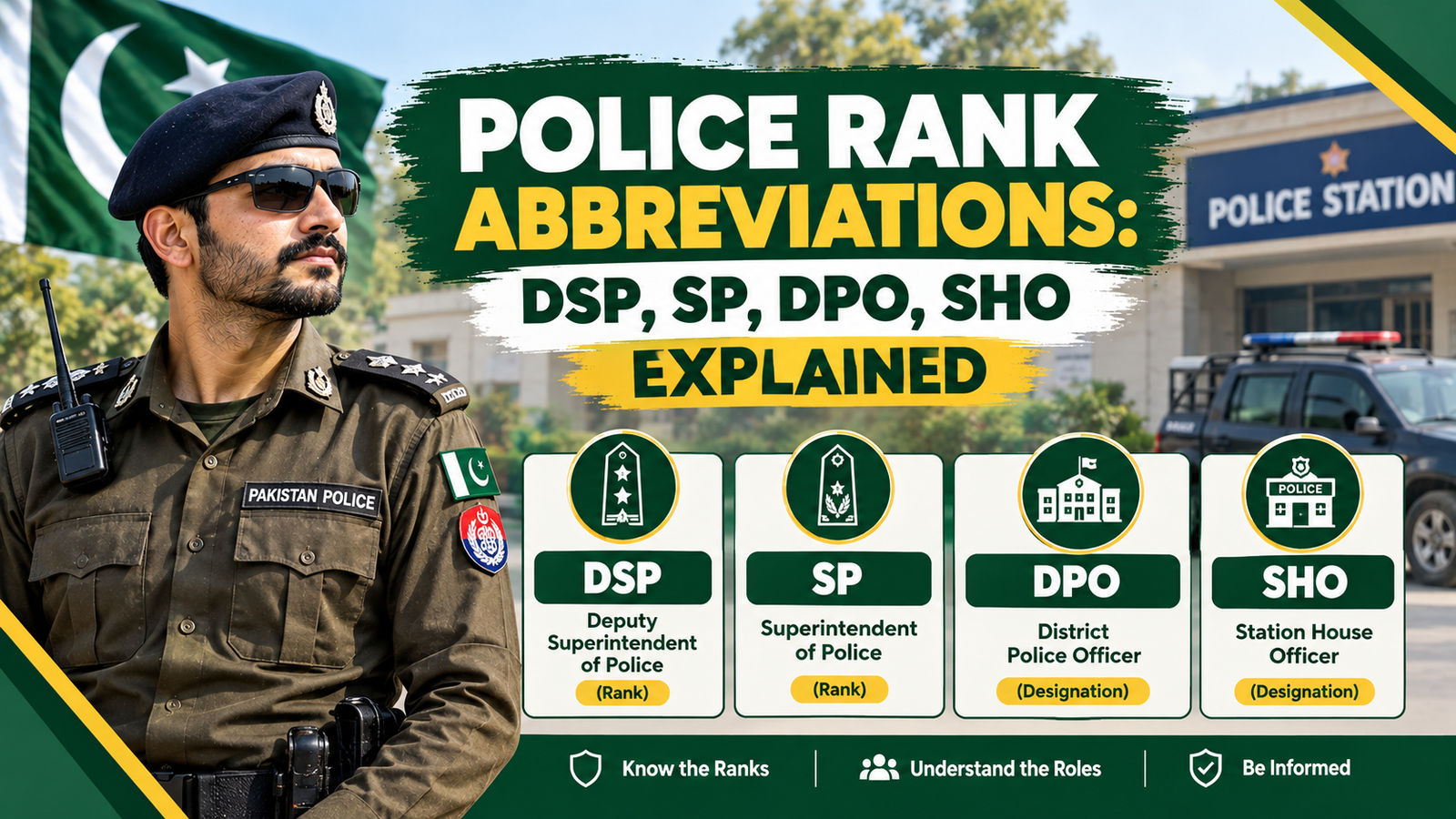
DSP stands for Deputy Superintendent of Police, a BPS-17 rank in Pakistan’s police hierarchy, ranking above Inspector and below SP (Superintendent of Police). DSPs typically oversee a sub-division within a district and can be recruited directly or through promotion from lower ranks.
Most pages answer “what does DSP stand for” with a single line and stop there, leaving you to search again for SP, SHO, and DPO separately. I’ve worked in HR for five years, and one thing I always tell people trying to make sense of unfamiliar abbreviations is: look them up together, not one at a time, because half of them only make sense in relation to each other. In my experience, this scattered approach is exactly why the rank-versus-post confusion never fully clears up for most readers. This guide covers 14 commonly searched police abbreviations in one place, organized by BPS grade, plus the genuinely useful distinction between actual ranks and assigned job titles. For the full career hierarchy and promotion path, our Police Ranks in Pakistan guide covers that in depth — this article is the quick-reference companion.
Police Rank Abbreviations by BPS Grade
Abbreviation: PC — Full Form: Police Constable — BPS Grade: BPS-05
Abbreviation: HC — Full Form: Head Constable — BPS Grade: BPS-07
Abbreviation: ASI — Full Form: Assistant Sub-Inspector — BPS Grade: BPS-9 or BPS-11 (varies by province — see note below)
Abbreviation: SI — Full Form: Sub-Inspector — BPS Grade: BPS-14
Abbreviation: Inspector — Full Form: Police Inspector — BPS Grade: BPS-16
Abbreviation: ASP — Full Form: Assistant Superintendent of Police — BPS Grade: BPS-17
Abbreviation: DSP — Full Form: Deputy Superintendent of Police — BPS Grade: BPS-17
Abbreviation: SP — Full Form: Superintendent of Police — BPS Grade: BPS-18
Abbreviation: SSP — Full Form: Senior Superintendent of Police — BPS Grade: BPS-19
Abbreviation: AIG — Full Form: Assistant Inspector General — BPS Grade: BPS-19
Abbreviation: DIG — Full Form: Deputy Inspector General — BPS Grade: BPS-20
Abbreviation: Addl. IG — Full Form: Additional Inspector General — BPS Grade: BPS-21
Abbreviation: IGP — Full Form: Inspector General of Police — BPS Grade: BPS-22
Honest note on ASI’s grade: Sources genuinely conflict here — one provincial police record lists ASI at BPS-9, another at BPS-11. Rather than pick one, I’m presenting both, since this may reflect real provincial variation rather than an error in either source.
Q: What does DSP stand for in police?
DSP stands for Deputy Superintendent of Police, a BPS-17 rank that sits above Inspector and below SP in Pakistan’s police hierarchy. DSPs typically oversee a sub-division within a district and hold a supervisory role over Inspectors, Sub-Inspectors, and constables working under them. This rank can be reached either through direct recruitment via the Public Service Commission exam or through promotion from within the ranks over a full career.
Q: What does SP stand for in police?
SP stands for Superintendent of Police, a BPS-18 rank that sits directly above DSP in the hierarchy. An SP typically oversees an entire district’s police operations, making it a significantly broader area of responsibility than a DSP’s sub-division. This rank is one step up from DSP and one step below SSP, following the standard progression most officers move through over their career.

These Are Posts, Not Ranks — A Critical Distinction
This is genuinely the most misunderstood part of Pakistani police terminology, and it’s the single question I get asked most often when this topic comes up. SHO, SDPO, DPO, CPO, RPO, and PPO are assigned job titles — positions — not separate ranks in the official hierarchy. An officer holding one of the actual ranks above (Sub-Inspector, DSP, SP, DIG, etc.) gets assigned to one of these positions based on where they’re posted, not because it’s a new rank they’ve earned.
Abbreviation: SHO — Full Form: Station House Officer — Typically Held By: Sub-Inspector or Inspector
Abbreviation: SDPO — Full Form: Sub-Divisional Police Officer — Typically Held By: DSP or ASP
Abbreviation: DPO — Full Form: District Police Officer — Typically Held By: SP or SSP
Abbreviation: CPO — Full Form: City Police Officer — Typically Held By: SSP or DIG-level officer
Abbreviation: RPO — Full Form: Regional Police Officer — Typically Held By: DIG
Abbreviation: PPO — Full Form: Provincial Police Officer — Typically Held By: Senior officer, typically Addl. IG or above
Abbreviation: CCPO — Full Form: Capital City Police Officer — Typically Held By: Senior officer, typically DIG or above
These city/region/province-level posts can look similar at a glance, so it helps to separate them by scope: RPO covers a region spanning multiple districts, CPO covers a single major city’s police force, CCPO specifically covers a provincial capital or the federal capital’s police force, and PPO sits at the top overseeing province-wide operations. The key difference is simply the size and level of the area each post is responsible for, not a difference in rank.
Why this matters practically: You might see a lower-ranked officer temporarily holding a higher-level post — this is normal and expected, since posts get assigned based on operational need, not strictly by rank seniority alone.
Q: What does SHO stand for and is it a rank?
SHO stands for Station House Officer, and it is a post, not a rank. It’s the officer assigned to head a specific police station, and that officer typically holds the actual rank of Sub-Inspector or Inspector. Because SHO is a job assignment rather than a rank you’re promoted into, you won’t find it listed anywhere in the official rank hierarchy — searching for “SHO rank” specifically won’t return a result in any legitimate BPS grade chart.
Q: What is the difference between DPO and DIG?
DPO (District Police Officer) is a post typically held by an officer with the rank of SP or SSP, and it refers to the officer in charge of an entire district. DIG (Deputy Inspector General) is an actual rank, BPS-20, that sits well above SP and SSP in the hierarchy, and an officer holding the DIG rank might be assigned to oversee a region (as an RPO) or a major city (as a CPO) rather than a single district. So DPO is a job title tied to district-level command, while DIG is a formal rank tied to a specific BPS grade.

Worked Example — Understanding a Career Path Through These Abbreviations
Suppose an officer enters police service directly at the ASP/DSP level through the Public Service Commission exam, holding a Bachelor’s degree and meeting the age requirement of 21-28 years.
- He starts at BPS-17 as a DSP, initially assigned as an SDPO (Sub-Divisional Police Officer) overseeing one sub-division within a district.
- After gaining experience, he’s promoted to BPS-18 as an SP, and may now be assigned as a DPO (District Police Officer), overseeing an entire district.
- Further promotion takes him to BPS-19 as an SSP. Using our confirmed BPS chart figures, BPS-19 starts at a minimum pay of Rs. 105,510 — compared to his starting DSP-level BPS-17 minimum, that’s a jump of two full pay grades over the course of these two promotions, translating to a meaningfully higher minimum salary at each step even before annual increments are counted.
- Eventually reaching BPS-20 as a DIG, he might be assigned as an RPO (Regional Police Officer) overseeing multiple districts within a region.
Why this matters: Notice how the actual rank (DSP, SP, SSP, DIG) stays consistent with his BPS grade at each stage, while the specific post he’s assigned (SDPO, DPO, RPO) changes based on where he’s needed — this is exactly the rank-versus-post distinction that trips up so many people searching for these terms.
Salary Reference for ASP/DSP
One consistently cited figure across sources, and one I’d treat as a reasonable starting reference rather than an exact promise: ASP and DSP salaries range from approximately Rs. 30,370 to Rs. 76,370. This figure appears on multiple sources with reasonable consistency, though — as flagged in our broader Police Ranks article — it’s worth cross-referencing against confirmed BPS-17 figures in our BPS Salary Chart guide for the most current pay structure, or checking directly with a provincial police department such as Punjab Police for the current official figure.
Q: What is the minimum qualification to become a DSP?
A Bachelor’s degree, representing 14 years of formal education from an accredited university, is the minimum qualification for direct entry as an ASP or DSP. Candidates must also fall within the age range of 21 to 28 years at the time of application. This makes DSP a notably more accessible entry point into the officer ranks compared to reaching the same BPS-17 grade through years of promotion from Constable or ASI level.
Other Related Abbreviations Worth Knowing
ITP — Islamabad Traffic Police, a distinct organizational unit (not a rank or post) responsible for traffic enforcement specifically in Islamabad.
PSP — Police Service of Pakistan, the parent civil service cadre that senior police officers (typically BPS-18 and above) belong to.
The Short Version
DSP stands for Deputy Superintendent of Police (BPS-17), SP stands for Superintendent of Police (BPS-18), and both are actual ranks with confirmed BPS grades. SHO, SDPO, DPO, CPO, RPO, and PPO, by contrast, are assigned posts — not ranks — typically held by officers of specific ranks based on where they’re posted. The full rank ladder runs from Constable (BPS-05) through IGP (BPS-22), with ASI’s exact grade varying slightly by province between BPS-9 and BPS-11 across sources reviewed.
FAQs
What does DSP stand for in police?
DSP stands for Deputy Superintendent of Police, a BPS-17 rank sitting above Inspector and below SP in Pakistan’s police hierarchy.
What does SP stand for in police?
SP stands for Superintendent of Police, a BPS-18 rank that oversees an entire district’s police operations, one level above DSP.
What does SHO stand for and is it a rank?
SHO stands for Station House Officer. It’s a post, not a rank, typically held by an officer with the rank of Sub-Inspector or Inspector.
What is the difference between DPO and DIG?
DPO (District Police Officer) is a post typically held by an SP or SSP overseeing a district. DIG (Deputy Inspector General) is an actual BPS-20 rank, well above SP and SSP.
What is the minimum qualification to become a DSP?
A Bachelor’s degree (14 years of education) and an age between 21 and 28 years, for direct entry via the Public Service Commission exam.
What does RPO stand for in police?
RPO stands for Regional Police Officer, a post typically held by an officer holding the DIG rank, overseeing multiple districts within a region.

One Comment on “Police Rank Abbreviations DSP SP DPO SHO Explained”