By Noman Arshad

Police ranks in Pakistan run from Constable (BPS 5-7, entry level) through Head Constable, Assistant Sub-Inspector, Sub-Inspector, Inspector, DSP, SP, and up to Inspector General of Police (IGP), the highest rank. Titles like SHO, DPO, and CPO are assigned positions, not separate ranks, and salary figures vary significantly across sources.
Most rank-and-salary pages online repeat the same numbers from each other without checking whether those numbers actually make sense together. I’ve worked in HR for five years, and one thing I always tell people comparing pay figures is: if two sources disagree by double or triple on the same rank, at least one of them is wrong. This guide lays out the full rank hierarchy, clearly separates actual ranks from job titles that get mistaken for ranks, and is honest about where salary figures genuinely conflict rather than picking whichever number sounds most authoritative. Police in Pakistan operates under the Police Order 2002 framework, and since policing is a provincial matter, exact administrative details can vary slightly between Punjab, Sindh, KP, and Balochistan, even though the core rank structure stays broadly consistent nationwide. For the application side of things, our Punjab Police Jobs 2026 guide covers eligibility and how to apply.
The Full Rank Hierarchy – Lowest to Highest
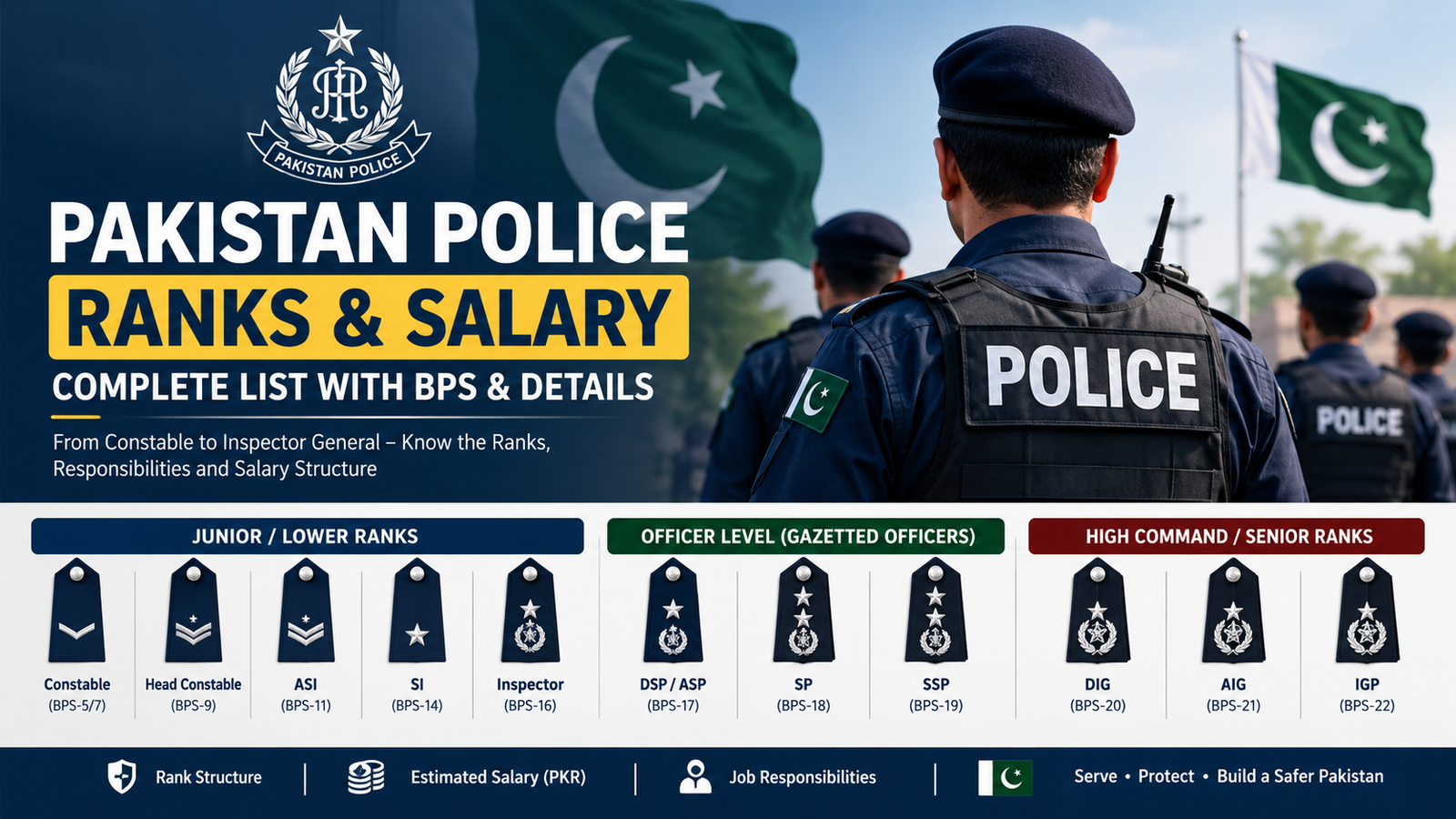
Pakistan’s police ranks are organized into junior and senior tiers, tied to the Basic Pay Scale (BPS) system used across Pakistani government service. For province-specific rank structures, the Punjab Police official portal is the authoritative source, since police administration is a provincial matter in Pakistan. If you want the full BPS grade chart with confirmed 2026 figures, our BPS Salary Chart 2026 guide has that in detail — this table anchors each rank to its BPS grade rather than repeating unverified rupee figures.
Rank: Constable — BPS Grade: BPS 5–7 — Tier: Junior
Rank: Head Constable — BPS Grade: BPS 7–9 — Tier: Junior
Rank: Assistant Sub-Inspector (ASI) — BPS Grade: BPS 9–11 — Tier: Junior
Rank: Sub-Inspector (SI) — BPS Grade: NOT AVAILABLE (a specific numeric BPS grade wasn’t confirmed, though SI carries a two-star insignia) — Tier: Mid
Rank: Inspector — BPS Grade: BPS 16 — Tier: Mid
Rank: Deputy Superintendent of Police (DSP) — BPS Grade: BPS 17 — Tier: Senior
Rank: Superintendent of Police (SP) — BPS Grade: BPS 18 — Tier: Senior
Rank: Senior Superintendent of Police (SSP) — BPS Grade: BPS 19 — Tier: Senior
Rank: Deputy Inspector General (DIG) — BPS Grade: NOT AVAILABLE (may serve as RPO or CPO) — Tier: Senior
Rank: Additional Inspector General (Addl. IG) — BPS Grade: NOT AVAILABLE — Tier: Senior
Rank: Inspector General of Police (IGP) — BPS Grade: BPS 21 or 22 — Tier: Senior
Honest note: These BPS grades for Inspector through SSP, and IGP, are now confirmed across two independent sources that agree with each other, which gives more confidence than the single-source figures used elsewhere in this article. DIG and Additional IG grades still weren’t confirmed with a specific number, so they remain NOT AVAILABLE rather than guessed.
Q: What are all the police ranks in Pakistan from lowest to highest?
Starting from the lowest: Constable, Head Constable, Assistant Sub-Inspector, Sub-Inspector, Inspector, Deputy Superintendent of Police, Superintendent of Police, Senior Superintendent of Police, Deputy Inspector General, Additional Inspector General, and finally Inspector General of Police, the highest rank in the force. Each rank carries increasing authority and responsibility, with junior ranks (Constable through ASI) handling day-to-day policing and senior ranks overseeing districts, regions, or entire provincial forces.
Ranks vs. Positions: A Distinction Almost No One Explains Clearly
This is genuinely important and gets confused constantly, including on other pages covering this exact topic. Titles like SHO (Station House Officer), DPO (District Police Officer), RPO (Regional Police Officer), CPO (City Police Officer), and CCPO (Capital City Police Officer) are not ranks — they’re assigned positions or job titles given to an officer holding a specific rank.
Term: SHO (Station House Officer) — Rank or Position?: Position — Typically Held By: Sub-Inspector or Inspector
Term: DPO (District Police Officer) — Rank or Position?: Position — Typically Held By: SP or SSP
Term: RPO (Regional Police Officer) — Rank or Position?: Position — Typically Held By: DIG-level officer
Term: CPO (City Police Officer) — Rank or Position?: Position — Typically Held By: SSP or DIG-level officer
Term: CCPO (Capital City Police Officer) — Rank or Position?: Position — Typically Held By: Senior officer, typically DIG or above
This table makes the distinction concrete: none of these five titles appear in the actual rank hierarchy table above — they’re assignments layered on top of a rank, which is exactly why searching for “SHO rank” won’t turn up a fixed answer in official rank charts.
For example, an SHO is typically a Sub-Inspector or Inspector who has been assigned to head a specific police station. A DPO is typically an SP or SSP assigned to head a district’s police force. The rank determines where an officer sits in the hierarchy; the position determines what specific job they’re doing at that point in their career.
Q: Is SHO a rank or a position in Pakistan Police?
SHO stands for Station House Officer, and it’s a position, not a rank. An officer holding the rank of Sub-Inspector or Inspector is typically the one assigned to the SHO role at a specific police station. This distinction matters because someone searching for “SHO rank” won’t find it in the official rank hierarchy — it’s an assignment given to an officer based on their actual rank, similar to how a Captain in the military might be assigned as a company commander without “company commander” being a separate rank.

Rank Insignia – How Stars Identify Rank
Like Pakistan’s armed forces, each police rank carries a distinct insignia worn on the shoulder, and stars are the most recognizable marker of seniority. Two confirmed reference points: Sub-Inspector carries a two-star insignia with a red-blue striped ribbon, and Inspector General of Police is specifically a three-star appointment. Specific star counts for every rank in between weren’t consistently confirmed across sources for this article, so rather than guess at the exact insignia for each mid-tier rank, I’d point readers to their provincial police department’s official uniform regulations for the complete visual reference.
Q: How many stars does an Inspector have on their badge?
A precise, confirmed star count specifically for the Inspector rank wasn’t available from sources reviewed for this article. What is confirmed is that Sub-Inspector carries two stars, and IGP is a three-star appointment, giving a general sense of how insignia scales with seniority. For an exact visual reference at every rank, checking official provincial police uniform regulations is more reliable than relying on informal breakdowns circulating online, since insignia details can vary slightly by province.
Junior Ranks – Constable Through ASI
These form the backbone of day-to-day policing:
Constable: Entry-level rank, BPS 5–7. Minimum education is Matric, with an age requirement typically between 18 and 26 years. Responsibilities include patrolling, traffic control, and assisting senior officers.
Head Constable: BPS 7–9, ranks above Constable. Often supervises junior constables and handles minor investigations under senior officer guidance.
Assistant Sub-Inspector (ASI): BPS 9–11, the first rank in this tier often involved directly in investigative duties, working under a Sub-Inspector or Inspector.
Honest note on junior-rank salaries: Even at this level, sources disagree substantially. Constable salary is cited anywhere from roughly Rs. 25,000-30,000 to Rs. 48,000-62,000 depending on the source, and ASI salary is cited anywhere from roughly Rs. 40,000-50,000 to Rs. 80,000-120,000. Given this spread, I’d treat any single number you see quoted online with caution — the BPS grade (5-7 for Constable, 9-11 for ASI) is a more stable reference point than the rupee figures currently circulating, and checking our BPS Salary Chart article for the confirmed grade-specific figures is more reliable than any single “police salary” page.
Q: What is the salary of a Sub-Inspector in Pakistan?
Confirmed, specific salary figures for Sub-Inspector weren’t available from sources reviewed for this article that I’d consider reliable enough to state as fact. Sources describing nearby ranks like ASI show wide disagreement — some citing figures two to three times higher than others — which suggests genuine uncertainty in publicly available data rather than a single settled number. Rather than repeat an unverified figure, I’d recommend checking the current advertisement or official pay notification for the most accurate current figure.
Worked Example — Understanding Rank Progression by BPS Grade
Suppose someone joins as a Constable at BPS-7 and is promoted over the course of a career.
- Constable (BPS 5-7): Entry point, minimum Matric education. Using our confirmed BPS chart figures, BPS-5 starts at Rs. 18,300 minimum, while BPS-7 sits between BPS-5 and BPS-10 — meaning even staying at Constable level, a promotion from the lower to upper end of this rank’s grade range could mean a meaningful jump in minimum pay, based on confirmed BPS-5 (Rs. 18,300) versus BPS-10 (Rs. 21,680) figures — a difference of Rs. 3,380 in minimum pay alone, before annual increments are factored in.
- Head Constable (BPS 7-9): First promotion, typically after years of service and performance.
- ASI (BPS 9-11): Second promotion, first rank with meaningful investigative responsibility.
- From ASI onward, further promotion to SI, Inspector, and beyond typically depends on seniority, performance, and available vacancies, though the exact BPS grades for these mid-to-senior ranks weren’t confirmed in sources reviewed for this article.
Why this matters: Each promotion typically corresponds to a jump in BPS grade, which — as our BPS Salary Chart article shows — comes with a meaningfully higher minimum and maximum pay, plus different allowance calculations. Understanding your current or target BPS grade is more useful for financial planning than relying on a rank-labeled salary figure that might not reflect your specific grade within that rank’s range.

Senior Ranks – DSP and Above
Moving into leadership positions:
Deputy Superintendent of Police (DSP): Ranks above Inspector, below SP. Can be recruited directly through the Public Service Commission exam.
Superintendent of Police (SP): Oversees a district-level police operation.
Senior Superintendent of Police (SSP): Senior district or specialized unit leadership.
Deputy Inspector General (DIG): Regional-level oversight.
Additional Inspector General (Addl. IG): Senior provincial-level leadership, just below IGP.
Inspector General of Police (IGP): The highest rank, overseeing an entire provincial police force.
Direct entry vs. promotion: DSP and equivalent officer-tier ranks can be reached two ways — direct entry through the Public Service Commission exam (age typically 21-28), or promotion through the ranks over a full career starting from Constable or ASI. Direct entry tends to reach these ranks faster but requires a Bachelor’s degree and passing a competitive exam; promotion from within takes considerably longer but doesn’t require the same entry exam, relying instead on seniority and performance over years of service.
Q: What is the difference between DSP and SP?
DSP (Deputy Superintendent of Police) ranks below SP (Superintendent of Police) in the hierarchy. A DSP typically oversees a sub-division within a district, while an SP has authority over an entire district’s police operations. Both ranks can be reached either through direct recruitment via the Public Service Commission exam or through promotion from lower ranks, though the DSP position generally represents an earlier stage in a career progressing toward SP and beyond.
Q: What is the minimum education required for each police rank?
Constable requires a minimum of Matriculation. ASI, SI, and Inspector-level positions can be joined directly through the Public Service Commission exam, which typically requires a Bachelor’s degree at minimum for direct entry at these levels. Higher ranks like DSP and above generally require a Bachelor’s degree as well, often obtained through direct Public Service Commission recruitment rather than promotion alone, though promotion from within the ranks remains a path to reaching senior positions over a full career.
Recent Salary Revisions
Something I always point out when explaining pay revisions to people: sources mention a 2023 provincial salary revision that included a 100% increase in basic pay plus a monthly allowance increase of roughly Rs. 10,000 to Rs. 12,800 across provinces. This kind of periodic revision means older salary figures circulating online — even ones that look “official” — may no longer reflect current pay, which adds to the confusion around conflicting numbers.
Note on high-end figures: Sources disagree substantially even on IGP pay specifically — one cited Rs. 400,000-600,000 per month, another cited a narrower Rs. 82,380-164,560 range. Neither figure lines up exactly with our own confirmed BPS-21 (max Rs. 261,560) or BPS-22 (max Rs. 293,350) data from the BPS Salary Chart article, though the lower figure is at least closer in order of magnitude. Rather than repeat either as fact, I’d treat the BPS grade itself (21 or 22, now confirmed across two sources) as the more reliable data point, and refer to our BPS chart for the actual pay range tied to that grade.
The Short Version
Police ranks in Pakistan run from Constable (BPS 5-7) through Head Constable, ASI, SI, Inspector (BPS 16), DSP (BPS 17), SP (BPS 18), SSP (BPS 19), DIG, Addl. IG, up to IGP (BPS 21/22), the highest rank. Titles like SHO, DPO, RPO, CPO, and CCPO are positions assigned to officers of a given rank, not separate ranks themselves. Salary figures for nearly every rank vary significantly across sources — sometimes by double or triple — so BPS grade is a more reliable reference point than any single rupee figure currently circulating online.
FAQs
What are all the police ranks in Pakistan from lowest to highest?
Constable, Head Constable, Assistant Sub-Inspector, Sub-Inspector, Inspector, Deputy Superintendent of Police, Superintendent of Police, Senior Superintendent of Police, Deputy Inspector General, Additional Inspector General, and Inspector General of Police.
What is the salary of a Sub-Inspector in Pakistan?
Confirmed salary figures weren’t available from reliable sources for this article. The specific BPS grade for Sub-Inspector also wasn’t confirmed, though the rank carries a two-star insignia.
Is SHO a rank or a position in Pakistan Police?
SHO stands for Station House Officer, and it’s a position, not a rank. An officer holding the rank of Sub-Inspector or Inspector is typically the one assigned to the SHO role at a specific police station.
What is the highest rank in Pakistan Police?
Inspector General of Police (IGP) is the highest rank, a three-star appointment carrying BPS grade 21 or 22, overseeing an entire provincial police force.
What is the minimum education for each police rank?
Constable requires minimum Matriculation. ASI, SI, and Inspector can be joined directly through the Public Service Commission exam, which typically requires a Bachelor’s degree for direct entry.
What is the difference between DSP and SP?
DSP (BPS 17) ranks below SP (BPS 18). A DSP typically oversees a sub-division within a district, while an SP oversees an entire district’s police operations.