By Noman Arshad
Pak Army online apply matric base recruitment lets Matriculation-pass candidates apply for Sipahi, Clerk, Technical, and Nursing Assistant trades through joinpakarmy.gov.pk. Matric Arts qualifies for Sipahi and Military Police; Matric Science is required for Clerk and Nursing Assistant. Age limit is 17.5–23 years, with relaxations available for specific categories.
Most matric-base guides repeat the same generic registration steps without answering the question candidates actually have: which trade am I even eligible for with my specific subject group? I’ve worked in HR for five years and regularly see how a simple Arts-vs-Science distinction trips up otherwise eligible candidates who assume all trades are open to everyone. This guide goes deeper into that trade-by-trade breakdown, and if you want the full registration walkthrough with dates and documents, our Join Pak Army Online Registration 2026 guide covers that in detail. If you’re a graduate rather than a matric-pass candidate, the officer route through PMA Long Course is a separate pathway entirely, with its own eligibility and selection process — this article focuses specifically on matric-base entry.
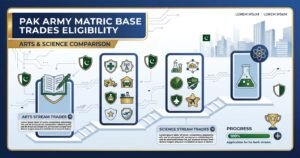
Which Trades Are Open on Matric Base
Not every trade accepts every matric background. This is the single biggest point of confusion candidates run into.
Trade: Sipahi (Regular Soldier) — Matric Requirement: Matric Arts or Science accepted — Gender: Male
Trade: Military Police — Matric Requirement: Matric Arts or Science accepted — Gender: Male
Trade: Clerk — Matric Requirement: Matric Science required — Gender: Male
Trade: Technical Trade — Matric Requirement: Matric Science or relevant Technical Diploma — Gender: Male
Trade: Nursing Assistant (AFNS) — Matric Requirement: Matric Science (Biology), minimum 60% marks — Gender: Female
Q: Can Matric Arts students join Pak Army?
Yes, but only for specific trades. Candidates who completed Matriculation in Arts are fully eligible for the regular Soldier (Sipahi) and Military Police branches, which make up the bulk of matric-base vacancies. However, Clerk and Technical roles specifically require a Science background, and Nursing Assistant requires Science with a Biology focus. If your matric is in Arts, your realistic options are Sipahi or Military Police rather than the full list of trades.
Age Limit and Relaxations
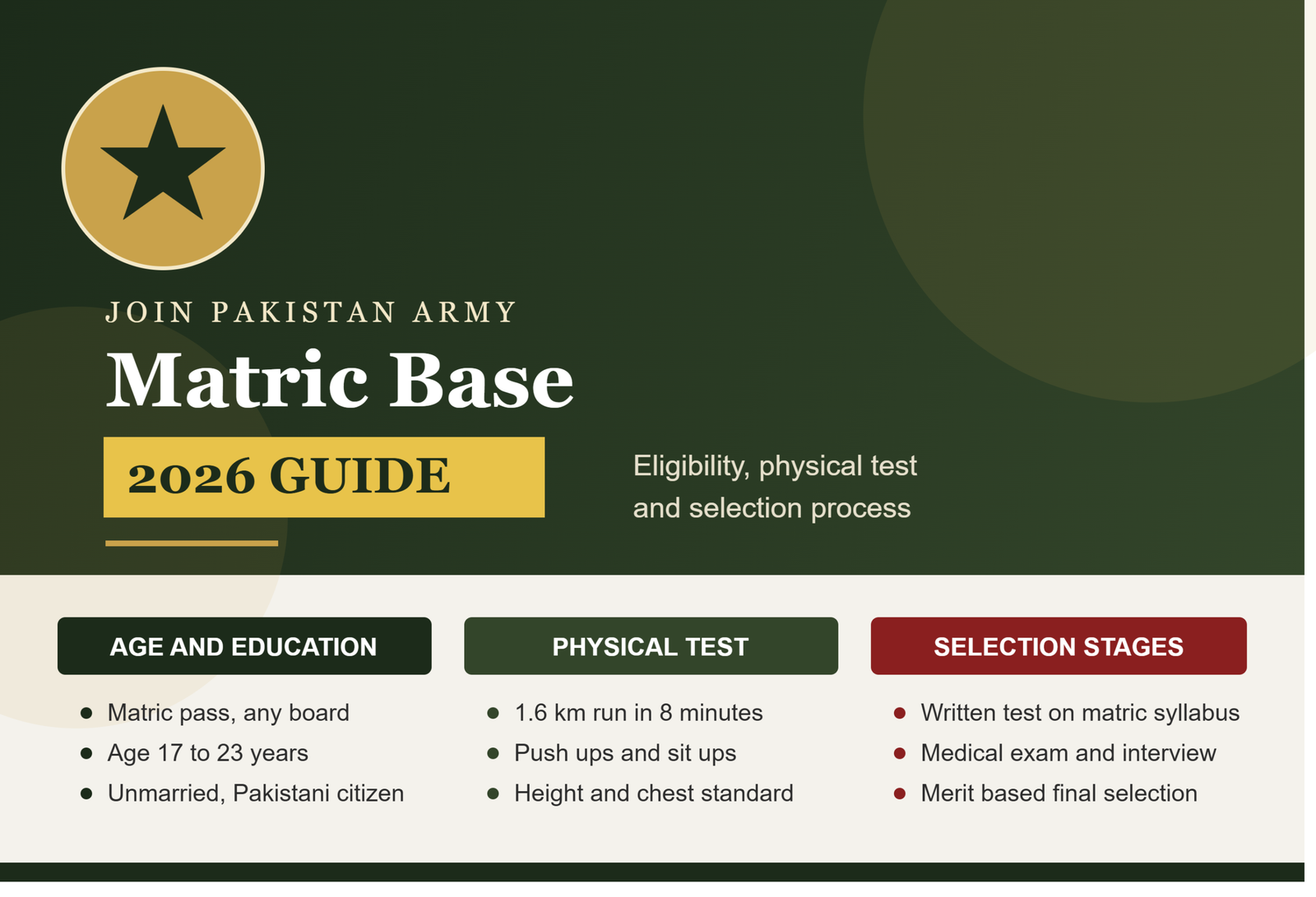
The standard age limit for matric-base candidates is 17.5 to 23 years at the time of registration. Several relaxation categories exist on top of this baseline:
- Candidates with higher qualifications may receive additional age relaxation.
- Candidates from martyrs’ families receive relaxation under official recruitment policy.
- Candidates holding a valid driving license (LHV) receive 2 years of age relaxation.
Female candidates applying through the AFNS Nursing Assistant route have a separate age bracket: 17 to 25 years.
Q: What is the age limit for Pak Army after Matric?
The general age limit is 17.5 to 23 years for male matric-base trades like Sipahi, Military Police, Clerk, and Technical roles. Female candidates applying through the AFNS Nursing Assistant route have a wider bracket of 17 to 25 years. Several relaxation categories apply on top of these baselines, including for higher qualifications, martyrs’ families, and valid driving license holders, so it’s worth checking whether you qualify for an extension before assuming you’re outside the limit.
Can Females Join Pak Army After Matric?
This is a genuinely common search, and the honest answer is more specific than most pages let on. Girls cannot join the regular infantry or Sipahi trade directly after Matric. The route that does exist is through the Armed Forces Nursing Service (AFNS) as a Nursing Assistant — this requires Matric Science with a Biology focus and a minimum of 60% marks, with an age bracket of 17 to 25 years.
Q: Can females join Pak Army directly after Matric?
Not through the regular Sipahi or infantry route — that path isn’t open to female candidates at the matric level. The established route for women is through the Armed Forces Nursing Service (AFNS) as a Nursing Assistant, which requires Matric Science with a Biology focus and at least 60% marks. This is a specific, defined pathway rather than a general matric-base option, so female candidates should target this route directly rather than assuming broader trade access.
Physical Standards for Matric-Base Candidates
Physical fitness is assessed alongside academic eligibility, and standards differ by gender:
Requirement: Height (most roles) — Male: 5’6″ minimum — Female: 5’2″ minimum
Requirement: Height (Technical Cadets) — Male: 5’4″ minimum — Female: NOT AVAILABLE
Requirement: Running — Male: 1.6 km in 8 minutes — Female: 1.6 km in 14 minutes
Requirement: Push-ups — Male: 15 in 2 minutes — Female: NOT AVAILABLE
Requirement: Sit-ups — Male: 20 in 2 minutes — Female: NOT AVAILABLE
Requirement: Chin-ups — Male: 3 repetitions — Female: NOT AVAILABLE
Requirement: Ditch Crossing — Male: 7’4″ x 7’4″ jump — Female: NOT AVAILABLE
Honest note: One source also cited a 5’8″ height figure specifically for a matric-base category, which doesn’t match the general 5’6″ standard listed elsewhere — this may reflect a specific trade (like Military Police, which typically has a higher height requirement) rather than a general contradiction, but I couldn’t confirm which trade it applies to specifically, so I’m flagging it rather than picking one. Since Military Police and similar trades sometimes carry a higher height requirement in certain listings, candidates should confirm their target trade’s specific standard directly on the current advertisement rather than assuming the general 5’6″ figure applies universally.
Worked Example — Matric Science Candidate Choosing Between Clerk and Technical Trade
Suppose a candidate passed Matric Science with 65% marks, is male, 18 years old, and 5’7″ tall.
- He checks joinpakarmy.gov.pk for the current active matric-base advertisement.
- Because his background is Science, he’s eligible for Sipahi, Military Police, Clerk, or Technical Trade — a wider set of options than an Arts-background candidate would have.
- He decides between Clerk (administrative, less physically demanding) and Technical Trade (requires more specific technical aptitude but often has better long-term specialization value).
- He registers online with his CNIC/B-Form, father’s CNIC, and exact matric marks entered carefully, since errors here can cause issues later.
- He selects his nearest AS&RC (Army Selection and Recruitment Center) as his test location.
- He submits the form and downloads his registration slip 48 hours later.
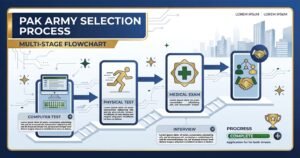
- At AS&RC, he sits the Initial Computer Test — Intelligence questions (Verbal and Non-Verbal) plus Academic questions based on his matric syllabus (Maths, English, Islamiat, Pakistan Studies).
- He proceeds through physical test, medical examination, and interview stages.
Why the trade choice matters: A Science-background candidate has more doors open than an Arts-background one, but that also means more decisions — Clerk and Technical Trade lead to different career tracks within the Army, so it’s worth researching each trade’s specific role before choosing rather than defaulting to whichever one appears first on the form.
Selection Process – What Happens After Registration
- Initial Computer Test at AS&RC — this is the matric-base written test, combining Intelligence questions (Verbal and Non-Verbal reasoning) with Academic questions based on matric-level syllabus (Maths, English, Islamiat, Pakistan Studies). It serves the same function as the “written test” referenced in general Pak Army registration guides, just delivered via computer at the AS&RC.
- Physical Test — running, push-ups, sit-ups, chin-ups, and ditch crossing, per the standards above.
- Medical Examination — a full health check; failing this stage disqualifies a candidate regardless of academic or physical performance.
- Interview and Religious Assessment — a final interview stage before merit-based selection.
After successful selection, matric-base recruits proceed to Basic Military Training, which runs for approximately 9 months at designated Army training centers before posting to a unit.
Q: Is prior experience required to apply for Technical Trade?
No, prior job experience isn’t mandatory for Technical Trade specifically. That said, candidates with relevant technical education, diplomas, or hands-on skills may have a practical advantage during the testing and training phases, since the trade builds on foundational technical aptitude. A candidate without prior technical exposure can still apply and succeed, but preparing with basic technical concepts beforehand can make the selection tests and subsequent training noticeably smoother.
Required Documents for Registration
Candidates should have the following ready, in original plus two attested copies, when registering at AS&RC:
- CNIC or B-Form (candidate’s own)
- Father’s CNIC
- Matric certificate showing exact marks
- Domicile certificate
- Recent passport-size photographs
Q: What does the Initial Computer Test actually cover for matric-base candidates?
The test combines two parts: Intelligence questions covering both Verbal and Non-Verbal reasoning, and Academic questions based directly on the matric syllabus, including Maths, English, Islamiat, and Pakistan Studies. This means preparation should focus on revisiting core matric-level concepts rather than assuming the test requires anything beyond what candidates already studied. Since this test happens at the AS&RC before the physical stage, candidates who prepare academically first tend to have one less thing to worry about on test day.
Salary and Stipend
Here’s the honest breakdown, and something I always clarify for people comparing job options: during training, recruits receive a stipend rather than a full salary. Confirmed figures for the exact training stipend amount were NOT AVAILABLE from sources reviewed. After completing training and being posted to a unit, the starting basic salary is cited as roughly Rs. 30,000 to Rs. 40,000 per month, though this figure appears consistently across sources without an official primary citation, so I’m treating it as a commonly reported range rather than an officially confirmed figure. On top of this, recruits receive free housing, food, and medical facilities.
Note on figures: I won’t state the stipend amount since no source confirmed it, and I’m flagging the Rs. 30,000–40,000 basic salary range as commonly cited rather than officially verified, consistent with how I handle uncertain figures throughout this series.
Is Online Registration Free?
Yes. Online registration through joinpakarmy.gov.pk is completely free. A nominal prospectus fee applies later in the process, though the exact amount was NOT AVAILABLE from sources reviewed for this article. One more thing worth knowing before you register: sources reviewed for this article show conflicting matric-base registration windows for 2026 — one cites 2 March to 22 May, another cites 16 April to 5 July, and a third mentions in-person AS&RC registration from 16 to 31 July. Rather than presenting one of these as the single correct date, I’m flagging that Pak Army recruitment, like Rangers and Police recruitment covered elsewhere on this site, appears to run in multiple phases or regional rounds throughout the year. Always confirm the currently active advertisement on joinpakarmy.gov.pk before registering, since a free registration process still requires you to catch the right window.
The Short Version
Pak Army online apply matric base recruitment opens Sipahi, Military Police, Clerk, Technical Trade, and Nursing Assistant (AFNS) roles to Matriculation-pass candidates through joinpakarmy.gov.pk. Matric Arts qualifies for Sipahi and Military Police only; Clerk, Technical Trade, and Nursing Assistant require a Science background. Age limit is 17.5–23 years for most male trades, with relaxations available, and 17–25 years for the female AFNS route. Registration is free, though 2026 dates vary across sources, so checking the current active advertisement is essential.
FAQs
Can Matric Arts students join Pak Army?
Yes, but only for Sipahi and Military Police trades. Clerk, Technical Trade, and Nursing Assistant require a Science background specifically.
What is the age limit for Pak Army after Matric?
17.5 to 23 years for most male trades, with relaxations for higher qualifications, martyrs’ families, and driving license holders. The female AFNS route has a 17 to 25 year bracket.
What is the salary of a Pak Army soldier after Matric?
During training, recruits receive a stipend (exact amount not officially confirmed). After training, the commonly cited starting basic salary is roughly Rs. 30,000 to Rs. 40,000 per month, plus free housing, food, and medical facilities.
Can females join Pak Army after Matric?
Not through the regular Sipahi route. The established path is through the Armed Forces Nursing Service (AFNS) as a Nursing Assistant, requiring Matric Science with Biology and at least 60% marks.
Is online registration for Pak Army free?
Yes, online registration through joinpakarmy.gov.pk is free. A nominal prospectus fee applies later in the process.
What is the physical test standard for Pak Army soldiers?
For men: minimum height 5’6″ (5’4″ for Technical Cadets), running 1.6 km in 8 minutes, 15 push-ups, 20 sit-ups, 3 chin-ups, and a 7’4″ x 7’4″ ditch crossing. For women: minimum height 5’2″ and running 1.6 km in 14 minutes.
Can you reapply if you’re not selected this time?
Yes, since Pak Army soldier recruitment runs across multiple registration windows throughout the year, candidates who aren’t selected in one round can apply again in a future round, as long as they still meet the age and eligibility criteria for their target trade.